
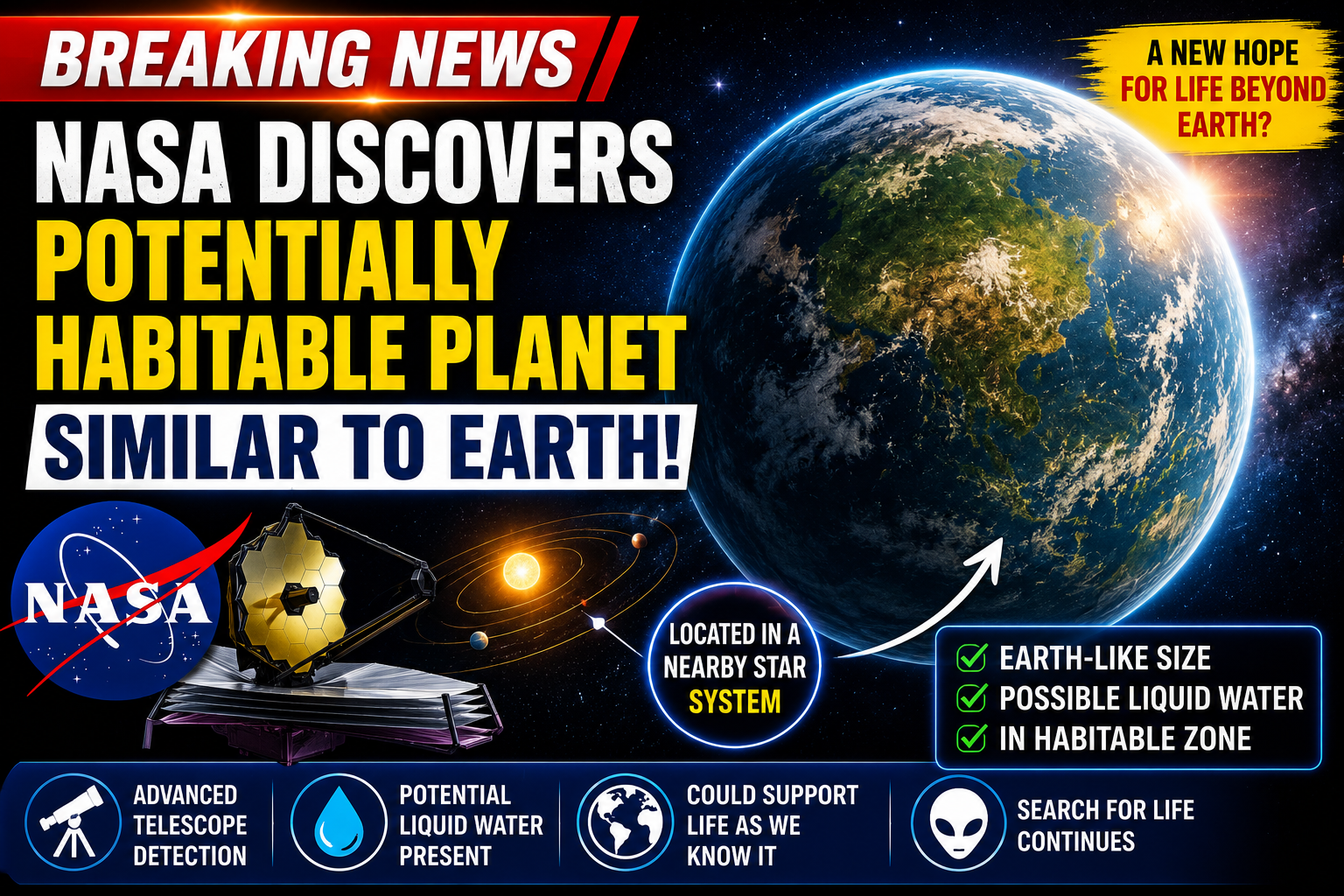
In a major breakthrough for space exploration, scientists working with NASA have announced the discovery of a potentially habitable exoplanet that shares several similarities with Earth. The newly identified planet is located in a nearby star system and has already generated excitement within the global scientific community.
Researchers believe the planet may possess environmental conditions that could support life, including moderate temperatures and the possible presence of liquid water — one of the most essential ingredients for life as we know it.
A Promising Discovery Beyond Our Solar System
According to NASA scientists, the exoplanet was identified using advanced space telescope technology designed to detect planets orbiting distant stars. Early observations suggest that the planet lies within the so-called “habitable zone,” where temperatures may allow water to exist in liquid form.
The planet is believed to be rocky, much like Earth, and may also have an atmosphere capable of supporting stable climate conditions.
Experts described the discovery as another important step in humanity’s search for life beyond Earth.
Scientists Continue Detailed Research
Astronomers are now conducting further studies to determine the planet’s atmospheric composition, surface conditions, and potential habitability. More detailed observations are expected through upcoming space missions and telescope analysis.
Scientists cautioned that while the discovery is promising, additional evidence is needed before confirming whether the planet can truly support life.
Why This Discovery Matters
The discovery could significantly improve our understanding of planetary systems and how life-supporting environments form across the universe.
Space researchers say such findings help scientists identify planets that may eventually become targets for future exploration missions.
The announcement has also sparked renewed public interest in astronomy, space science, and the possibility of extraterrestrial life.
Growing Global Interest in Space Exploration
In recent years, international space agencies have accelerated efforts to explore deep space and search for Earth-like worlds. Advancements in telescope technology and artificial intelligence are helping researchers analyze distant planetary systems more efficiently than ever before.
Experts believe discoveries like this could reshape humanity’s understanding of the universe and our place within it.