
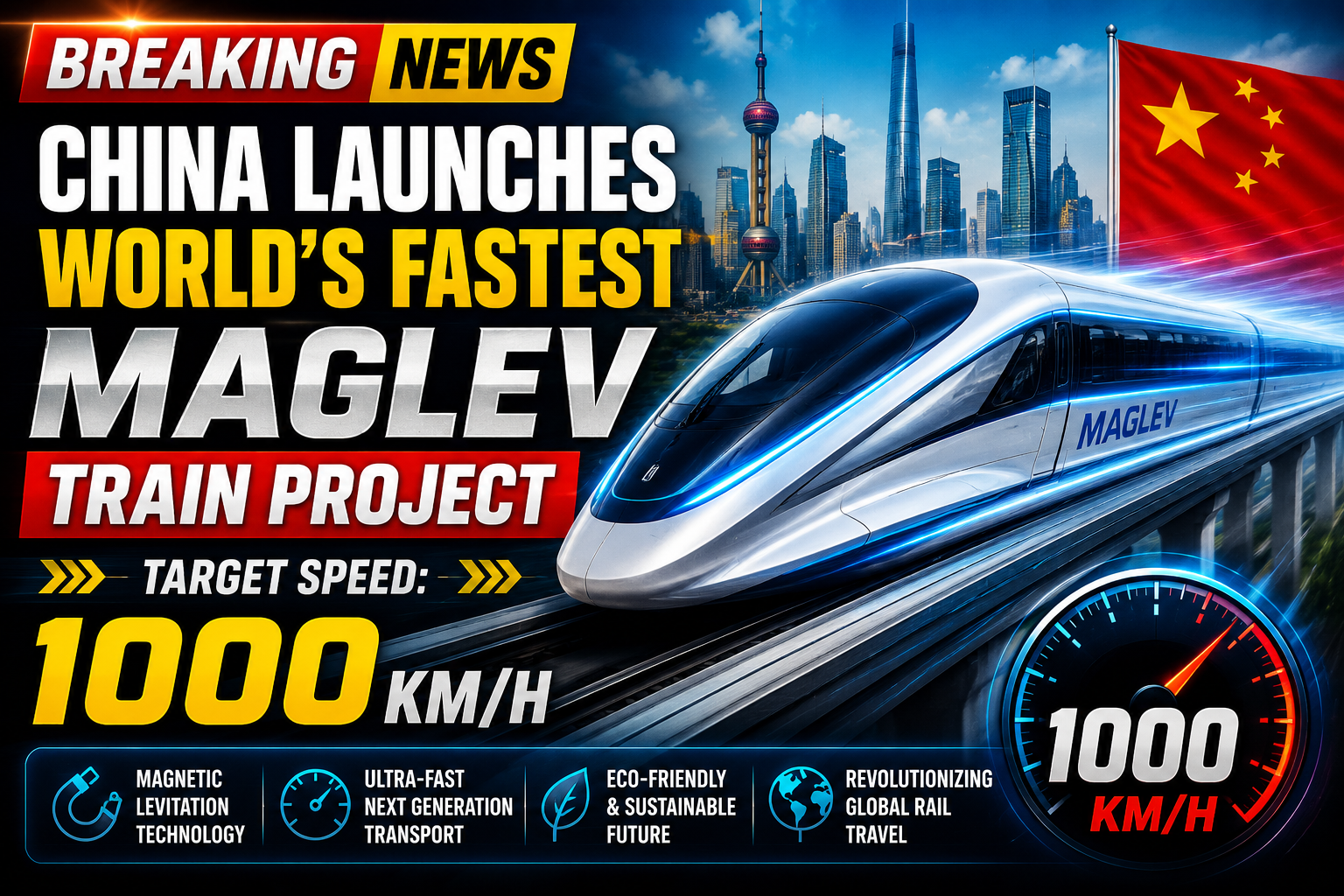
China has unveiled plans for a groundbreaking next-generation magnetic levitation (maglev) train project that could reach speeds of up to 1000 kilometers per hour, potentially transforming the future of high-speed transportation.
The ambitious project, currently under development by Chinese researchers and transportation authorities, is expected to combine magnetic levitation technology with low-vacuum tube systems to drastically reduce friction and air resistance. Experts believe the innovation could make long-distance travel faster, more efficient, and environmentally sustainable.
A Major Leap in Transportation Technology
According to reports, the futuristic transport system is designed to operate significantly faster than current commercial high-speed rail networks. If successful, the train could reduce travel times between major cities to just a few hours.
Chinese officials described the project as a major technological advancement aimed at strengthening the country’s leadership in advanced transportation infrastructure and smart mobility solutions.
The proposed train system would use powerful magnetic forces to lift and propel the train above the tracks, eliminating direct contact and enabling ultra-high-speed movement with minimal energy loss.
Potential Impact on Global Travel
Transportation experts say the project could redefine the future of rail travel globally. Analysts believe ultra-fast rail systems may eventually become an alternative to short-distance air travel, reducing airport congestion and carbon emissions.
The project also reflects growing international competition in advanced transportation technologies, with several countries investing heavily in sustainable and high-speed mobility solutions.
Focus on Sustainability and Innovation
Chinese researchers claim the next-generation maglev system is being designed with sustainability in mind. The project aims to reduce environmental impact while improving travel efficiency and passenger comfort.
Industry observers note that the success of such systems could open new opportunities in trade, tourism, and economic connectivity across regions.
Challenges Ahead
Despite the excitement surrounding the announcement, experts caution that the project still faces major engineering, safety, and infrastructure challenges before large-scale commercial deployment becomes possible.
Building vacuum tube corridors, maintaining safety at extreme speeds, and managing operational costs remain key hurdles for the project.
However, if completed successfully, the maglev system could become one of the most significant transportation breakthroughs of the decade.